An ABC Award has been bestowed on yours truly and this humble blog, ’12 Notes & the Truth!’ Thanks so much to my blogging colleague on the other side of the pond…Heavy Metal Overload…a true music fan if ever there was one…make sure you pay his blog a visit!!!
Without doubt the hardest part of this ABC list was deciding on a topic. I have been so busy, performing, teaching and networking that I didnt have a lot of time to devote to this spot for a while. My first and favorite idea was to write a description of each musical key, A, B, C…. Even the novice can see the flaw in that theory. The musical alphabet ends on letter G what would I do with H-Z? And what about the ‘#’ & ‘b’ keys??…scrap that idea.
Went through a host of other blah ideas before it hits me! Why I am trying to be so cute just write about what I know…the guitar!!!
So here it is the A-Zs of the worlds greatest instrument…the guitar!
A, AXE- Ever heard the term axeman? Well unless it is some crazy Jack Nicholsonesque dude it refers to a guitarist(no jokes please)….the axe being his guitar. Of course every other instrument has had to steal the idea…there’s just something uncool about hearing a saxophonist saying he “needs to grab his axe.” Here is Michael Schenker an axeman supreme on, “Attack of the Mad Axeman.” BTW the ‘axeman’ on the left of the video doubling on keyboards is San Diego’s own Wayne Findlay and one of my music buds back in our younger days. Have I ever mentioned that? Haha, well guess I am just proud to see one of us San Diego kids living the Rock n Roll dream!
B, BLUES- Sure, blues is not necessarily a guitar term, but, can you imagine the world without blues guitar? No Robert Johnsons who influenced the BB Kings who influenced the whole Jimi Hendrix, Jimmy Page, Eric Clapton generation who influenced the whole Eddie Van Halen generation who influenced me and my generation…I would be calling my saxophone an ‘Axe’ if it wasn’t for this lineage. Oh yeah don’t forget Stevie Ray Vaughan!
Dreadnought Guitar Body Shape
C, Capo- A capo is a small clamp that guitarists place at different frets on the neck to change the ‘key’ of the guitar which facilitates easy transitions to other keys.
D, Dreadnought- A Dreadnought guitar is a style/body shape made famous by C.F. Martin. The term ‘Dreadnought,’ was used in reference to the British Navy’s large battleships of the day, early 1900’s.
These guitars are characteristic in having large ‘squared’ bouts and a booming sound.
F, Fifth-Now some of you are really interested! No not a fifth of Jack…the musical interval of a perfect 5th. The fifth is the skeleton of all chords(Maj. & Min.) and for rock guitarists extremely important for the formation of power chords which are made up exclusively of the interval of root & 5th.
G, Golpe- Golpe is a technique stemming from the Spanish/Gypsy Flamenco tradition. The guitarist strikes the top of the guitar creating a percussive sound while strumming with other fingers. Note the use of the previously mentioned capo in the video, as well.
H, Harmonics- Harmonics are not exclusive to guitar by any means but they do play a large role in playing guitar. The technique actually cuts off part of the overtone series(lower end) which make up a musical note. The resulting sound resembles a high, thin, bell like texture. The intro of Van Halen’s “Top Jimmy,” uses this technique.
Check out Ibanez, Vai Guitars
I, Inlay- Inlays are part of the artistic design of a guitar. Inlay can be placed all around the sound hole(rosette) soundboard, front, back and sides of a guitar. Some of the fanciest inlays are put into the neck of a guitar. Sometimes just dots and sometimes elaborate as seen here.
J, Jimi Hendrix Chord, The ol’ Dominant 7#9 chord! Also called a V7#9. To build this chord you would take your root chord say C7 and add the note ‘#9’ which is the 9th note above C -C, D, E, F, G, A, B, C, D and raise that note one half step to D#. The chord symbol will appear as: C7#9, etc., for any root note. I call it the Jimi Hendrix chord cause he used it a lot and when I was a kid learning his songs is when I was first introduced to the chord. Check out Foxy Lady or Purple Haze for examples. The sound is a bit bluesy and has some dissonance with the #9 against the Major 3rd.
K, Keys- The guitar has a handful of musical keys that are conducive to the instrument and a handful that are not! Guitarists tend to like sharp(#) keys vs flat(b) keys. Flat keys take away the open strings making the guitar harder to play as noted in the letter O, Open Chords. Popular guitar keys include C, G, D, A and E (as well as, their relative minor keys). Any key with more than one flat is often avoided especially by beginners.
L, Lick- This is a great guitar word somewhat synonymous with the term ‘Riff.’ Guitarists practice hours on end trying to create new ideas and phrases which are, ‘Licks,’ and ‘Riffs.’ Licks are more of short phrases placed in improvised solos while riffs are more like a composed guitar part think of the intro to “Smoke on the Water,” or “Iron Man.”
M, Mute- The most common type of muting is done by placing the palm of the strumming hand against the strings near the bridge of the guitar. Notation is often ‘P.M.’ for palm mute.
N, Nut- The nut is simply the piece of bone or plastic, among other possible materials, at the top of the neck. It has carved slots for the strings to rest inside which keeps them inline as they lead up to and wrap around the tuning pegs.
O, Open Chords- One of the nice things about the guitar especially for beginners is the use of open chords. They are somewhat simple to play as they make use of a combination of fingered/fretted notes and open strings. Bar chords are harder to play as all strings need to be fretted.
P, Percussion- Believe it or not the guitar is classified as a percussion instrument, not a string instrument(chordophone.) By definition a percussion instrument is one that is put into vibration by being struck and consequently the pitch fades away. Piano is another such ‘percussion’ instrument. Electric guitars fall into another category, that of ‘electronic’ instruments. Electronic instruments can have their sound altered and lengthened through electronic means.
Q, Quadrant- This is a term I use to differentiate parts of the neck. I divide the neck into sections for study. For instance I will play on the bottom three strings first 6 frets. In this territory I will work on as many permutations of a particular scale, arpeggio etc. Then move to the top three strings same frets. Then down to fret 7-12 on each side of the strings.
R, Rasgueado- Spanish term meaning to strum. Usually associated with Flamenco guitar playing. Rasgueado is a rhythmic use of the fingers and thumb while strumming a guitar. It is a percussive strum by nature. In the video watch how his fingers fire in succession.
S, Solo- The beloved guitar solo! Ruined forever since the demise of rock. This demise can be traced to the weak musicality typically displayed in late 80’s hair/glam metal giving way to Grunge. Grunge was a movement that sought to distance itself from the aforementioned Hair Bands.
Maybe ruined forever is a bit harsh, but, music sure has changed since the early 90’s. I grew up on the rock guitar solo and it is not something I want to see go away. It is often the most musically adventurous part of most pop music. My music heroes were the guitar solo shredders…Eddie Van Halen, Michael Schenker, Jimi Page, Randy Rhoads, Tony Iommi, Steve Vai, Joe Satriani…. Here is the quintessential rock guitar solo Eddie Van Halen’s Eruptions.
T, the ‘Thumb’- The Thumb is the nickname given to jazz guitar legend Wes Montgomery. His unique technique employed a drastically positioned thumb. One of my all-time favorite guitarists.
U, Upstroke- An upstroke is simply a strum across the strings in an upward motion. Typically, upstrokes happen on a weak beat. A strum of down-up-down-up etc. would sound as STRONG-weak-STRONG-weak.
V, Vibrato- Vibrato is a technique employed by stringed instruments where the string is actually moved in a controlled manner either ‘side to side’ or ‘up and down’ to add articulation to a note. As mentioned before the guitar is a percussion instrument. Vibrato is one of the few ways we as guitarists can actually manipulate a note after it is struck into motion.
W, Whammy Bar- Also called a vibrato bar, tremolo arm…The whammy bar is a short piece of metal(a stick) inserted into the bridge which can either lift or depress the bridge forcing the strings into some ‘unnatrual’ sounds. The whammy bar in the hands of an amateur becomes a gimmick. In the hands of a skilled musician it becomes a devastating way to command a guitar with unique and angular articulations.
X, X Bracing- Have you ever dropped a pick inside your guitar? No problem you can just slide it out right? Nope. The top of a guitar, the soundboard, is braced underneath with a lattice of wood to help project the sound off the top of the guitar. One technique of bracing is called X Bracing.
Y, Yuquijiro Yocoh- Was a Japanese guitar composer (1925-2009.) Yocoh is most well-known for his variations on the theme of the traditional Japanese folk song, “Sakura.” I played the piece for my Senior Recital in college and still play it to this day. The video features John Williams on guitar. Listen for the previously mentioned palm mutes at :40 & 4:25 and harmonics at 2:25.
Z, The Flying Z- Most people even non guitar aficionados have heard or seen a flying V guitar. But, lesser known is the flying Z also known as a Destroyer.
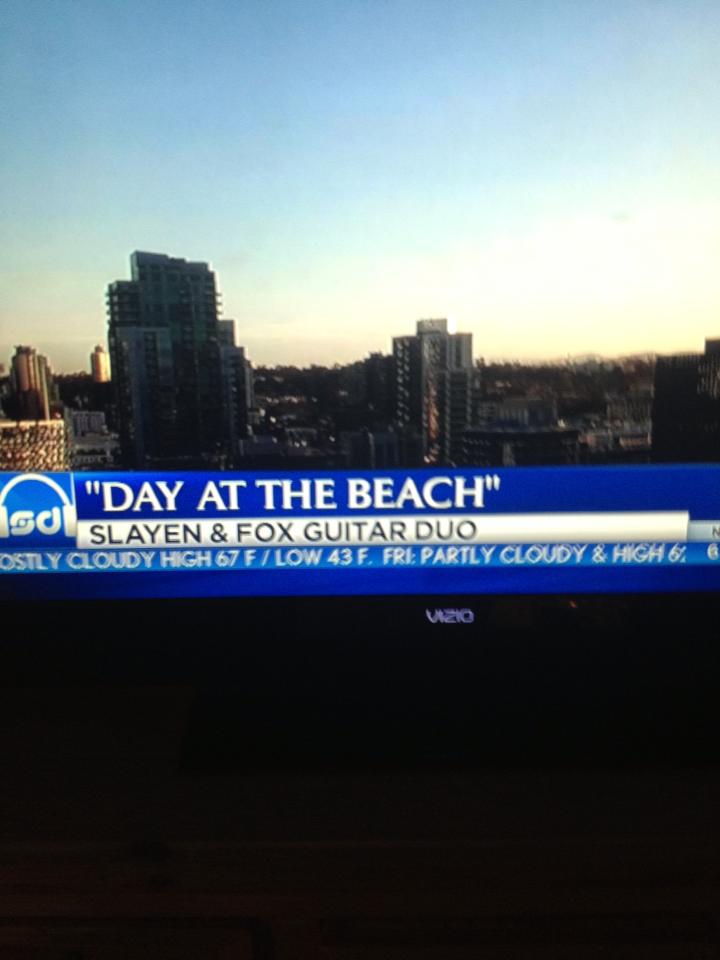
This was a cool way to kick off a Thursday! Watching KNSD 7/39 News and hearing my song, “Day at the Beach,” on their broadcast.
Try your favorite online music player to hear the song. I believe it is on Rhapsody not sure where else…but, let me know where you find it! For those of you so inclined to buy check out the ITunes link on the side widget===========>>
A little blood pumping ‘classical’ music for your Monday morning. Chopin was actually a composer during the Romantic Period (1820-1910). He lived 39 short years, 1810-1849, but, left an amazing musical legacy in his piano works.
I know for those of you back East it was an extremely rough winter. In San Diego not so much we had our bits of rain and frost, but, also plenty of 70 degree plus days, as well.
Thought I would honor the first day of Spring with Aaron Copland’s famous piece, “Appalachian Spring.” Beautiful melodies, lush orchestration and a pastoral setting of Americana, including his use of the Shaker tune, “A Gift to be Simple.”
Copland was a very innovative composer of the 20th Century, however, became known for and remembered much more for his ‘romanticized,’ settings of Americana which only accounted for a brief period of his compositional output. If you are interested try the following link for a different look into Copland’s work.
In the past, I have written about relaxing music and what makes it relaxing. The words that I come up with over and over again are spacing and open-ness. Most of my previous posts focused on these traits in regards to the harmonies(chords) and rhythms.
In ‘Un Bal,’ Berlioz uses another technique in addition to these, orchestration. One of my favorite aspects of composing and listening to music is that of orchestration. The combination of instruments and timbres(sounds). When in the hands of a master, I believe, that even inferior melodic/harmonic music can be made great.
Berlioz often uses sparse groups of instruments including solos. When the music does get more dramatic he tends to feature the strings and woodwinds over the heavier brass timbres, of the later Romantics such as Mahler and Wagner. The use of a harp adds to the dulcet nature of the piece.
Enjoy!
The creator of the embedded video supplies some great commentary. For those of you trying to gain insights into classical music make sure you check out their other videos, as well.
The 2013 Academy Awards are all set to be broadcast this weekend. A time for movie goers to celebrate their favorite films and actors of the year. A time for millionaire actor$ and billionaire $tudios to finally be bestowed some actual credit for their hard work. 😉
Of all the yearly award shows the Oscars is my favorite. Much more than the Grammys, my own industries honors. Even more than the ESPYs…wait do we really need a sports award show? Isn’t that why they play the games to figure out who’s the best?
Of course my favorite awards of the night are for my favorite part of most movies…the music! Best original score and best original song.
Nominees for Best Original Score:
While all are very well composed scores with interesting soundscapes, there were none that were truly unique or mind-blowing, over the top. That said…
A nice combination of modern technology and middle-east flavors. In my opinion the synth driven background is not as difficult in compositional nature as Lincoln and Anna Karenina.
Danna sets a very nice mood with the peaceful score in Life of Pi. The use of eastern instruments and ideals lends perfectly to the movie. In my opinion the score is a bit too minimalist and might suffer from its demure sonic atmosphere.
I am really impressed with this one. When I first heard Williams was penning the music for Lincoln I kind of rolled my eyes. ‘Lets use the biggest name in the film scoring business.’ He tends to be bombastic and his moves often have a similar style. However, I really like what he did for Lincoln. Williams did a great job composing Americana music, as well as, setting traditional songs of the day. Maybe not some of his most memorable sounds, but, some of his truly best artistically and structurally!
This is a cool fun score. Newman did a great job interpreting the James Bond theme we all love with some techno beats and backgrounds. I think this nomination will suffer from being a 007 film and similar to Argo I don’t think this piece had the same compositional chops as Lincoln and Anna Karenina.
So you can probably already tell where I am going with this pick. In my opinion it is definitely between Lincoln and Anna Karenina. My personal vote would be for Lincoln. I am torn on who I think the Academy has picked. The slightly superior Lincoln or the more artistic Anna Karenina.
Gotta go with my gut…
The Oscar for Best Original Score, Goes To…John Williams for Lincoln!!
Here are some of the key points to my recent UCSD lecture on music of the Baroque, Classical and Romantic periods.
Dates
Baroque 1600-1750 The end of the Baroque period corresponds with arguably the greatest composer of the era, J.S. Bach’s death in 1750.
Classical 1750-1820 There is much debate regarding the transition date between Classical and Romantic periods largely focused on Beethoven and which period he belonged.
Romantic 1820-1910 The Romantic period ended early in the 20th Century as an artistic movement. However, in music it is still largely utilized in popular media most noticeably in the film scores of John Williams.(Star Wars, Indiana Jones, Harry Potter)
Definitions
Baroque -Originally a derogative term to describe a mis-shapen pearl due to the music’s ornateness stemming out of the more ‘refined’ renaissance period.
Classical -Highly formulaic and stylistic. The term ‘Classical’ is often employed when discussing all ART music from Middle Ages through Modern styles.
Romantic -In reaction to classic ideals. Romantics strove to push the envelope and express nature and the human spirit.
Classical –Homophonic, One main melody over chords(most pop music is homophonic)
Romantic –Chromatic, All twelve notes of the octave became important during this period vs. the propensity to concentrate on the seven belonging to each key.
Romantic –Rise of the virtuoso/self promotion, Much in the way bands today distribute fliers for their shows musicians had to pave their way and make a name for themselves.
Global
Baroque –Nationalistic, There were several ‘schools’ of composition in Europe. Italian, French, German, English…
Classical –International, Throughout Europe, Western classical music could be heard with similar styles and tastes.
Romantic –Nationalistic, Once again styles were locally influenced. In the Romantic period composers actually incorporated local folk music into their works. This created more of an ethnic diversity than the individual stylistic schools of the Baroque.
Examples
Baroque, This is a great illustration of the multiple voices that are integral to Baroque style
Classical, The following clip displays the grace and highly stylistic nature of the era.
Romantic, Compare the grandiose individualistic nature of the following Mahler excerpt to the stylistic Mozart piece above.




 Mike Slayen ~ Guitarist