Key Points from My Lecture on Baroque, Classical and Romantic Music

Here are some of the key points to my recent UCSD lecture on music of the Baroque, Classical and Romantic periods.

Dates

Baroque 1600-1750 The end of the Baroque period corresponds with arguably the greatest composer of the era, J.S. Bach’s death in 1750.

Classical 1750-1820 There is much debate regarding the transition date between Classical and Romantic periods largely focused on Beethoven and which period he belonged.

Romantic 1820-1910 The Romantic period ended early in the 20th Century as an artistic movement. However, in music it is still largely utilized in popular media most noticeably in the film scores of John Williams.(Star Wars, Indiana Jones, Harry Potter)

Definitions

Baroque -Originally a derogative term to describe a mis-shapen pearl due to the music’s ornateness stemming out of the more ‘refined’ renaissance period.

Classical -Highly formulaic and stylistic. The term ‘Classical’ is often employed when discussing all ART music from Middle Ages through Modern styles.

Romantic -In reaction to classic ideals. Romantics strove to push the envelope and express nature and the human spirit.

Style/Texture

BaroquePolyphonic, Multiple simultaneous melodies creating harmonies(chords)

ClassicalHomophonic, One main melody over chords(most pop music is homophonic)

RomanticChromatic, All twelve notes of the octave became important during this period vs. the propensity to concentrate on the seven belonging to each key.

Composers

Baroque -Handel, Vivaldi, J.S. Bach

Classical -Haydn, Mozart, Beethoven

Romantic -Schubert, Chopin, Brahms, Liszt, Wagner, Mahler

Society

How musicians were chiefly employed

BaroqueChurch, sacred music

ClassicalCourt, employed by the monarchy

RomanticRise of the virtuoso/self promotion, Much in the way bands today distribute fliers for their shows musicians had to pave their way and make a name for themselves.

Global

BaroqueNationalistic, There were several ‘schools’ of composition in Europe. Italian, French, German, English…

ClassicalInternational, Throughout Europe,  Western classical music could be heard with similar styles and tastes.

RomanticNationalistic, Once again styles were locally influenced. In the Romantic period composers actually incorporated local folk music into their works. This created more of an ethnic diversity than the individual stylistic schools of the Baroque.

Examples

Baroque, This is a great illustration of the multiple voices that are integral to Baroque style

Classical, The following clip displays the grace and highly stylistic nature of the era.

Romantic, Compare the grandiose individualistic nature of the following Mahler excerpt to the stylistic Mozart piece above.

Guitar Practice Tip, It Ain’t Like That…

This guitar practice tip may be one of the most important to keep in mind when learning the instrument(or anything new). Unfortunately, for some it might be one of the hardest pieces of advice to truly grasp and put in your tool box.

Recently, I’ve been reading about how adults learn vs. how children learn, not just guitar, but, in other areas like language, as well. As is often suggested, do kids really have a larger capacity to learn than adults? Looking back upon my most successful students over the years they all have had one thing….

As previously mentioned, it is often said that kids learn things so much easier. Brain science and genetics aside this may not be a true statement. In my experience teaching both adults and kids it has a lot to do with learning style.

Adults have learned how to learn already. We learn how to study, play sports and drive for success. There are as many strategies for tackling new things as there are people trying new things.

Kids are more pliable in their learning styles. More willing to take to heart what teachers suggest. Without as much life experience, they are more open to just purely DOING something new and seeing what happens.

By the time we are adults we have developed certain preconceived notions how to learn  things. An athlete may learn by taking new experiences head on with brute force and strength. An engineer may face things analytically, breaking down problems, systematically and logically solving the unknown.

How we were brought up determines how we learn, as well…good ol’ nature vs. nurture.

Athletes pound it out, music ain’t like that…

Salesmen don’t take no for an answer, music ain’t like that…

Students work extremely hard studying to do well on tests, music ain’t like that…

Where am I going with all this? Teaching thousands of students from 4 year olds to elderly and all ages in between over the past 20 years one thing stands out.

To go Yoda on you, …”Try not. Do, or do not. There is no try.”

Yeah it is kind of ‘use the force’ when learning music.

-You may need to check your learning and drive for success styles at the door when trying an instrument. (Although they may help some they may ultimately hinder you, as well)

-You need to be open to exposing yourself a bit by dropping your pre-conceived notions for success in other fields.

…So what is the one thing my most successful students possessed?

They had an adaptable approach…They knew when to push hard and when to let off the gas. When to listen and when to attack. On and on…

In essence they had a flexible approach rather than a rigid pre-learned approach to learning and achieving musical success.

Bottom line approach the guitar with an open mind!

Be willing to learn in a different way than you’ve previously had success in other areas of life, when needed.

Above all, at all levels of your journey enjoy playing!!

Happy Thanksgiving!

Thank you all for following my blog! I appreciate all of you who follow and chat about my favorite subject…..MUSIC!

Thank you to all my wedding and performance clients, fellow musicians and students….it is a pleasure to share music with all of you!

It’s the Most Wonderful Time of the Year…

Well it’s definitely that time already in the music teaching biz!

If you are like me, you know it is way too early for Christmas music, at least for listening. However, with student performances and CD recording projects coming up SOON it has been my experience that the day after Halloween needs to be the official start of practicing holiday music.

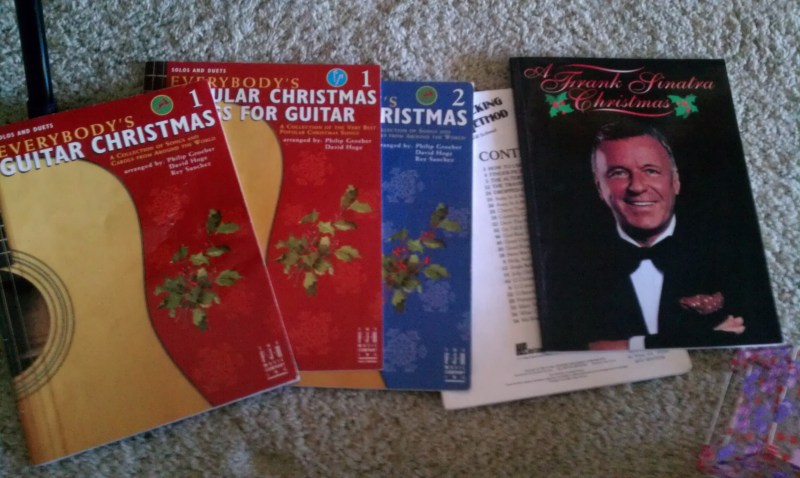
Gotta love the Frank Sinatra Christmas Songbook…has NOTHING to do with him other than the picture on the cover.


For those looking for music I strongly recommend the FJH series of Methods and Xmas books. I’ve been using them for 7 plus years now. Their books are a bit more contemporary than the ol’ standards. My students laugh cause I know what page every song is on….they test me but they never trick me.

Tips on practicing for the holidays…

-Don’t bite off more than you can chew! Pick one or two songs with arrangements at your skill level. Learn those and then dive into another. If you start too many at one time you might burn out and lose your steam.

-Practice at least one song you play the notes or tab and a couple with just chords. People love to sing their favorites this time of the year and you can strum away and accompany them.

-Have fun!! Making music with others is a blast. Be confident, but, don’t take it too seriously!

BONUS TIP: Unless you are really comfortable sight-reading make copies of the songs you intend to play and leave the book at home! If you have the book people WILL start to browse and make requests which can be an uncomfortable situation for beginners.

Good luck with the guitar this holiday season!

Related posts:

Guitar for your holiday events

Bing-a-Ling-a-Ling

Dodecaphonic Sudoku

Wow! Here is a serious brain teaser for music geeks.

For the uninitiated dodecaphony is a music term relating to the twelve notes we use in Western music… the basis of my blog 12 Notes & The Truth!

In the 1920’s Composer Arnold Schoenberg set out to compose music through a process that obliterated the systems we are/were used to hearing. Serialism is the name of the movement in which all twelve notes must be used before any are repeated. Creating no key centers in the composition and lack of melody and harmony as we are used to hearing.

The following puzzle is a take on dedecaphony. A Sudoku matrix set up where each note can only be used only once, horizontally, diagonally and in each of the 12 boxes of the matrix.

In essence there is no difference than converting a regular Sudoku puzzle to be 12 x 12 instead of the traditional 9 x 9. Where the numbers 1, 2, 3, 4, 5, 6, 7, 8, 9, 10, 11, 12 are replaced by the 12 notes in our chromatic scale A, Bb, B, C, Db, D, Eb, E, F, Gb, G, Ab. Once completed, a composer would take any of the rows horizontal or vertical and compose using those notes.
Complete Serialism proved to be a little restrictive and many composers have used this technique as a guideline rather than a steadfast rule.

Here is the puzzle. I haven’t worked it so cant guarantee its solve-ability. Have fun if you are so inclined!

This music wasn’t written to be scary or Halloween-ish although not a bad way to transition into October with this piece.

This is real music listen with open ears and an open mind!

Arnold Schoenberg’s, “Piano Concerto op. 42 (Excerpt)”

Enjoy!

Do You Remember the 21st Night of September? EWF

“September,” is truly one of the gems of the 70’s disco era…and who didn’t love Earth, Wind & Fire?

My favorite part…you guessed it…the opening guitar riff. Every time I hear the song I immediately try to picture how he is getting that snappy sound on his guitar. He might just be using the very edge of his pick, like a pick squeal technique without using the fleshy finger. However, it has a peculiar sound like he is actually pinching the string between his thumb and finger and snapping it, almost like you would do with a rubber band. When I play this song that is what I try to do. It is kind of hard to control each note since it is so quick which would mean he is a pretty skilled guitarist.

Here is it “September,” by Earth, Wind & Fire

What is a Picardy 3rd?

Alex Trebek, “The practice of ending a piece of music in a minor key on a major tonic chord”

…I am going to win one of you a Jeopardy answer someday! Remember this!

Not sure why but while studying music in college the topic of the Picardy 3rd was something that always came up in jokes and conversations between students. It may have to do with it just being a cool musical concept, it may be that is was one of the easier concepts to grasp for most music students, I’m just not sure. All I know is every time I hear it I want to do that stupid Beavis and Butthead laugh and say, “Uhhh-huhh, you said Picardy 3rd.”

It was a practice popularized in the Renaissance period 1400-1600. The origins of the name Picardy are not known for sure although some theorize it relates to the Picardy region of France.

So other than a joke between college musicians, winning Jeopardy or impressing your friends with a relatively useless piece of trivia how does this effect your life?

Well for those of you who write music try it! You will be amazed at the stark lifting statement a final major chord has on a minor keyed song. The half step raising of one note can substantially generate a physical impression on your listeners. And after all what are we trying to do as musicians…move our listeners!

Try it you’ll like it!

Here is Glenn Gould performing Johann Sebastian Bach’s Prelude in D minor BWV926 Listen for the difference between the final major chord and the rest of the piece in minor.